How to choose a key cutting machine for locksmith and shop work
What a key cutting machine actually has to do
A key cutting machine is a precision machine tool, even when it sits on a small bench. It has to hold the blank securely, follow a known pattern or code, remove material cleanly, and repeat the same geometry without drifting out of tolerance. For locksmiths, hardware stores, facilities teams, and mobile automotive service providers, the right machine depends less on the marketing label and more on the keys that must be cut day after day.
The central decision is straightforward: match the machine to the key profiles and workflow you can verify. A basic manual duplicator can be efficient for common edge-cut keys, but it will not replace a sidewinder cutter, dimple machine, tubular key machine, or electronic code machine. Manufacturer categories from Ilco and Silca separate edge-cut, laser, dimple, tubular, and special-key machines, reflecting real differences in clamping, cutter geometry, tracing, and software control. (ilco.us)

For broader shop planning around small machinery, tooling, and workflow, see the machine tools section.
Main types of key cutting machine
Most buying mistakes begin when different key cutting processes are treated as interchangeable. They are not. A machine that performs well on common residential keys may be the wrong investment for automotive sidewinder work. Likewise, a capable electronic code cutter may be unnecessary for a counter that mainly handles simple duplicate keys.
Manual edge-cut duplicators
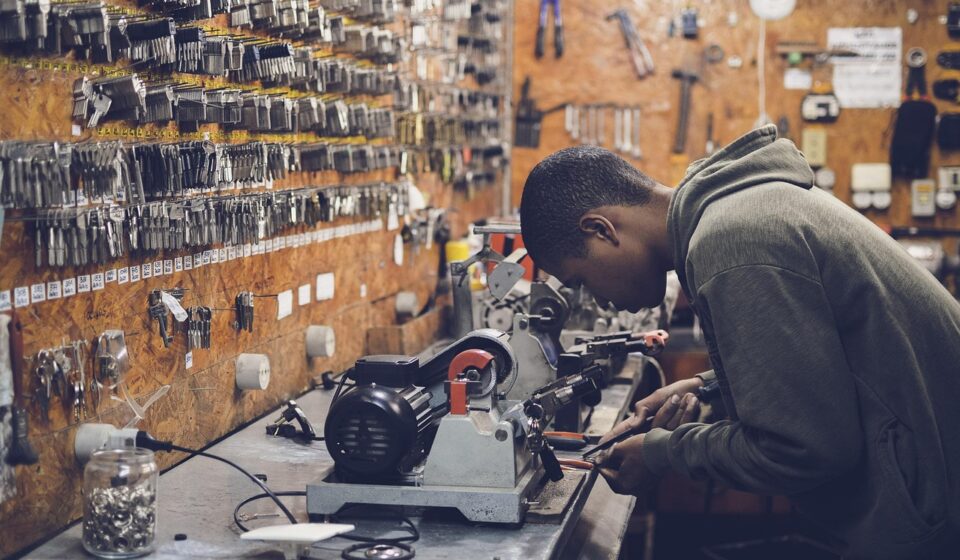
Manual duplicators are the familiar bench machines used for many flat residential, padlock, cabinet, and older automotive keys. One side holds the original key, the other holds the blank, and the operator guides the carriage so a tracer follows the original while a cutter shapes the blank. Their strengths are speed, simplicity, low training burden, and low cost per duplicate. Their limits are just as important: results depend on the condition of the original key, the operator’s technique, jaw condition, cutter sharpness, and calibration.
Automatic and semi-automatic duplicators
Automatic machines reduce manual carriage control. They can help a high-volume counter produce more consistent copies, especially where operators have mixed levels of experience. Automation, however, does not correct a worn original key, the wrong blank, poor clamping, or an incorrect stop position. These machines are best viewed as productivity tools, not as substitutes for process control.
Code cutting machines
Code machines cut a key from a known bitting specification instead of copying an existing key. This is useful when the original is badly worn, lost, or when a controlled system requires a key cut to specification. Electronic code machines may include databases, guided setup, interchangeable jaws, and software-driven depth and spacing control. The practical advantage is repeatability; the operational responsibility is that authorization and code control must be handled carefully.
Laser, sidewinder, dimple, tubular, and special-key machines
Sidewinder or laser-style automotive keys require different cutting geometry from standard edge-cut keys. Dimple keys, tubular keys, tibbe-style keys, and other specialty profiles also need dedicated jaws, cutters, tracers, or machine layouts. Some advanced machines combine several stations in one body. For example, Silca describes models that can handle flat, cruciform, laser, and dimple keys on one machine, but that capability still depends on the correct accessories, calibration, and the specific blank being used. (silca.biz)
Match machine capability to real shop demand
The most useful specification is not the longest feature list. It is the fit between the machine and the actual work mix. Before buying, a shop should review real requests over several weeks: residential cylinders, padlocks, restricted systems, safe deposit keys, automotive mechanical keys, transponder keys, sidewinder keys, fleet keys, institutional keys, and specialty items. A low-volume shop may gain more from a reliable edge-cut duplicator and a clear referral process for specialty work than from an expensive multi-function machine that is rarely used.
| Common work type | Suitable machine category | Important limitation |
|---|---|---|
| House, padlock, cabinet, and many standard flat keys | Manual or automatic edge-cut duplicator | Quality depends heavily on the original key and blank selection |
| Worn-key replacement when a code is available | Code cutting machine | Requires controlled access to accurate code information |
| Modern automotive sidewinder keys | Laser or sidewinder cutting machine | Mechanical cutting may not complete the job if immobilizer programming is required |
| Dimple, tubular, tibbe, or special profiles | Dedicated special-key machine or multi-station electronic machine | Needs the right jaw, cutter, tracer, and verified blank |
| Mobile locksmith work | Compact electronic or portable machine | Must tolerate transport, power variation, dust, and frequent setup changes |
Automotive work needs particular caution. The blade and the electronic credential are separate issues. Toyota owner support, for example, notes that vehicles with immobilizer systems may require the vehicle computer to be programmed to authorize the new key. That illustrates a broader industry point: a cutter shapes the metal or plastic blade, but it does not by itself solve every transponder or remote function. (support.toyota.com)
Accuracy factors that decide whether the finished key works
Key cutting accuracy comes from a chain of small controls. If one step is wrong, the finished key may stick, fail to turn, work only one way, or accelerate lock wear. The problem is often noticed at the lock, but the cause may sit much earlier in the process.
- Blank identification: The blade profile, shoulder, tip stop, milling, and material must match the lock system. Similar-looking blanks can still be wrong.
- Clamping and alignment: A blank that is tilted, stopped at the wrong reference point, or held in a worn jaw can produce a visible or hidden error.
- Cutter condition: A dull cutter heats the blank, leaves burrs, and can widen or distort cuts. Replacement cost should be part of the operating budget.
- Calibration: Tracer-to-cutter alignment, depth settings, carriage travel, and electronic axis calibration should be checked on a routine schedule.
- Deburring and inspection: Burrs can prevent smooth insertion or damage pins and wafers. Finished keys should be brushed, visually checked, and tested only in an appropriate, authorized lock.
For shops evaluating machines, sample cuts are more useful than brochures alone. Ask whether the machine can repeatedly cut the specific blanks the shop handles, how calibration is performed, which accessories are required, and how consumables are sourced. A lower-priced machine can become expensive if replacement cutters, jaws, software updates, or support are difficult to obtain.
Safety and maintenance should be part of the purchase decision
A key cutting machine is small compared with a milling center, but it still has rotating cutters, pinch points, metal chips, sparks in some operations, and electrical components. OSHA’s machine guarding guidance identifies hazards such as rotating parts, flying chips, and sparks as reasons to protect operators and nearby workers. (osha.gov)
Good shop practice starts with guards in place, eye protection, chip control, secure mounting, stable power, clean work surfaces, and clear separation between the cutter area and customer access. Operators should not reach into the cutting area while the machine is running, remove guards to speed up work, or use compressed air in a way that sends chips toward people. See also: cnc and robotics.
Maintenance also needs structure. Brushes, chip trays, belts, clamps, cutters, tracer points, and carriage slides wear over time. A simple maintenance log can record cutter changes, calibration checks, unusual vibration, electrical issues, and failed duplicates. During servicing or maintenance, OSHA’s lockout/tagout rule addresses the control of hazardous energy when unexpected startup or energy release could harm employees. (osha.gov)
Security, standards, and responsible operation
Key cutting is a manufacturing task tied directly to physical security. That makes process discipline as important as machine capability. Shops should maintain clear policies for restricted keyways, institutional systems, vehicle key codes, customer identity checks, employee access, and record retention where required by law or contract. Requirements vary by jurisdiction and customer type, so operators should not assume that a technically possible duplicate is automatically appropriate to make.
Standards also matter, although they usually apply to the lock and cylinder system rather than to a retail cutting counter alone. ANSI/BHMA A156.5 covers cylinders and input devices for locks and includes operational and strength testing requirements. For buyers, the relevance is practical: keys, cylinders, and hardware are part of a tested security system, so inaccurate duplication or uncontrolled key issuance can undermine the performance expected from the hardware. (webstore.ansi.org)
For facility managers, the safer approach is to document who may request keys, which blanks are controlled, how master key systems are protected, and when a lock should be rekeyed instead of duplicated. For locksmiths and hardware stores, responsible operation means training staff to refuse uncertain work, escalate restricted requests, and separate legitimate key origination from casual copying.
A practical buying checklist
Before comparing brands or prices, define the operating case. A key cutting machine should be purchased against a written checklist, not a vague plan to “do more key work.”
- List the key families you will cut: Include edge-cut, sidewinder, dimple, tubular, automotive, institutional, and specialty profiles.
- Estimate daily volume: A machine for five occasional copies has different requirements from a machine used continuously at a retail counter.
- Separate duplication from origination: Copying an existing key and cutting from code require different controls and operator knowledge.
- Confirm accessory requirements: Check jaws, cutters, tracers, adapters, calibration pieces, software, and update policies.
- Evaluate support: Local service, parts availability, documentation, and training are more important than small differences in advertised speed.
- Plan the work area: Provide lighting, chip collection, secure storage for blanks, a clean testing process, and safe customer distance.
- Set authorization rules: Decide how staff will handle restricted blanks, vehicle codes, master systems, and uncertain customer requests.
The best purchasing decision is usually not the most complex machine. It is the machine that cuts the verified workload accurately, safely, and repeatedly. For many shops, that may mean two focused machines instead of one overloaded platform. For others, a multi-station electronic machine may make sense because it reduces setup changes and supports a wider service mix. The right answer comes from measurable demand, not feature count alone.
Frequently asked questions
Can one key cutting machine cut every type of key?
No. Some machines cover multiple categories, but no shop should assume universal compatibility. Edge-cut, sidewinder, dimple, tubular, and other special keys can require different cutters, jaws, clamping methods, and software support.
Is an electronic key cutting machine always more accurate than a manual machine?
Not automatically. Electronic control can improve repeatability, especially for code cutting, but accuracy still depends on calibration, blank selection, cutter condition, and correct setup. A well-maintained manual duplicator can outperform a poorly maintained electronic machine on simple keys.
Does cutting an automotive key make it ready to start the vehicle?
Not always. Many vehicles use immobilizer or transponder systems. The mechanical blade may turn the lock, but the vehicle may also need an authorized electronic credential or programming step before it starts.
How often should a key cutting machine be calibrated?
The interval depends on use, machine type, and manufacturer instructions. High-volume shops should check calibration more frequently, especially after cutter changes, jaw replacement, transport, vibration, or a noticeable increase in failed duplicates.
What is the biggest mistake when buying a key cutting machine?
The biggest mistake is buying for theoretical capability instead of real demand. A shop should first identify the keys it cuts most often, the work it refuses or refers, the skills of its operators, and the security rules it must follow.